Thinning Hair in Your 30s or 40s? A Straight-Talking Guide to Hair Restoration for Men on the Upper East Side
ROW 89 Team • October 23, 2026 • 8 min read
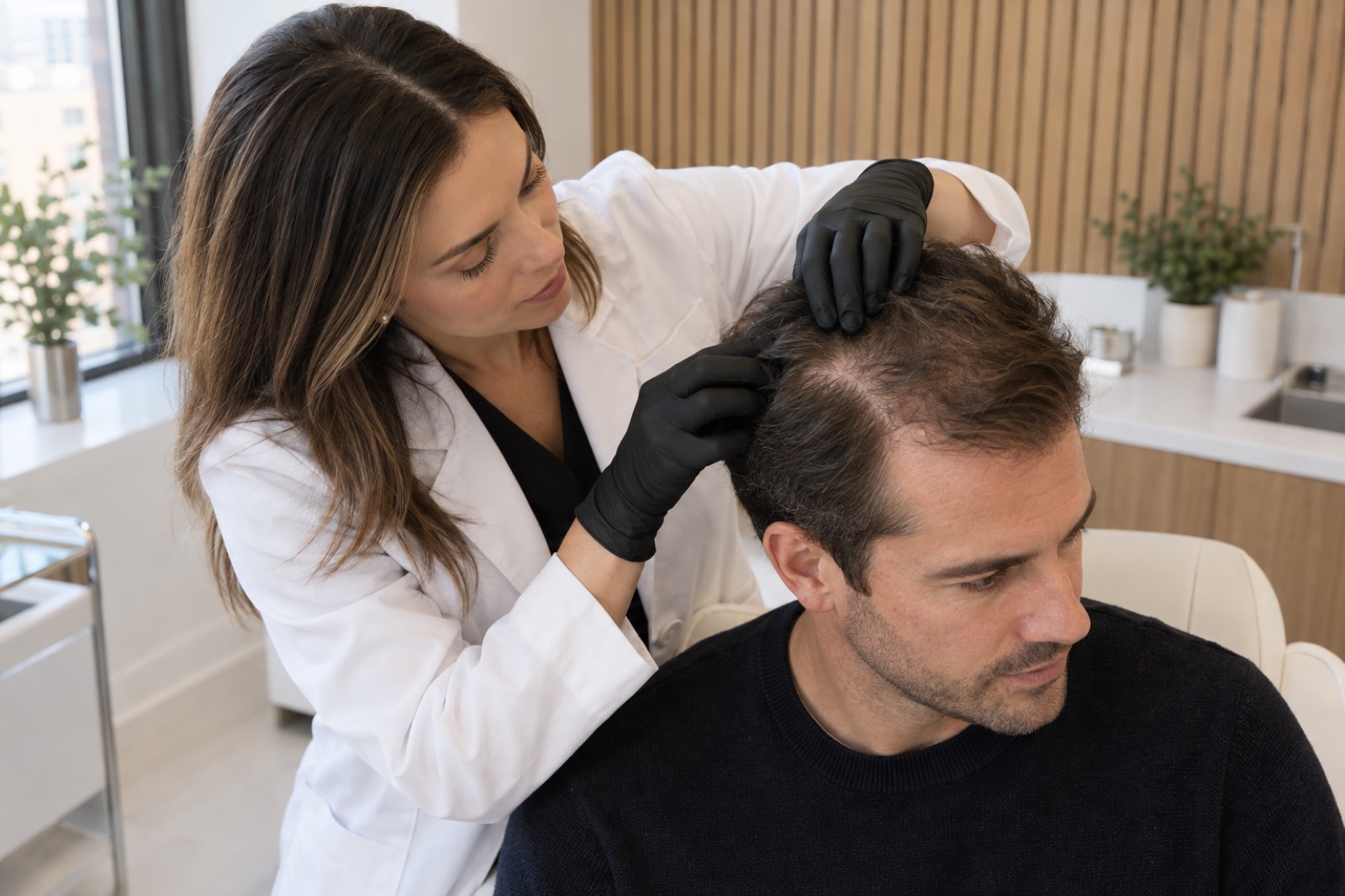
Mark noticed it in a wedding photo. Under the reception lights, the crown of his head looked thinner than it did in his bathroom mirror. A week later, in the elevator camera of his Carnegie Hill building, he saw it again.
He was 38. His father had lost most of his hair by 50, and Mark had always assumed he would deal with it "later." Suddenly later felt like now. He spent a few evenings reading forums, ordered a shampoo that promised a lot, and still didn't know what actually works.
Mark is a composite of clients we hear from often; names and details are changed.
More and more of the people who come to ROW 89 for hair mesotherapy are men like Mark: noticing early thinning and wanting a straight answer. This guide covers why men's hair thins, which treatments have the strongest evidence, where hair mesotherapy fits (and where it doesn't), and what a visit with Rocio Romero, PA-C, on East 89th Street looks like.
This article is general information, not medical advice. If your hair is falling out suddenly or in patches, or your scalp is painful, scaly or inflamed, please see a board-certified dermatologist or your doctor.
Why men's hair thins
The most common cause by far is male pattern hair loss, known medically as androgenetic alopecia. It's very common: according to Cleveland Clinic, about a quarter of men see the first signs before age 21, about half have some hair loss by 50, and about 70% lose hair as they age. MedlinePlus estimates it affects about 50 million men in the United States.
It's driven by genetics and a hormone called DHT, which the body makes from testosterone. In hair follicles that are genetically sensitive to it, DHT shortens the growing phase of each hair. Over time those follicles shrink, and the hairs they produce come in finer, shorter and lighter, until some stop growing visible hair at all. A 2025 review describes this process, called miniaturization, in detail.
The typical early signs:
- A hairline that recedes at the temples into an "M" shape
- Thinning at the crown, often noticed first in photos or overhead light
- Hair that looks finer or doesn't hold a style the way it used to
Male pattern hair loss doesn't hurt, and it tends to progress slowly. That slow pace is actually useful: it gives you time to act while there are still follicles to work with.
Rule out other causes first
Not all thinning is pattern hair loss. The American Academy of Dermatology lists many other causes, including:
- Stress-related shedding (telogen effluvium). A big shed a few months after a high fever, surgery, a major illness or losing a lot of weight. It often settles on its own.
- Alopecia areata. Round, smooth bald patches, sometimes in the beard or eyebrows too.
- Thyroid problems, low iron or other nutrient gaps.
- Some medications and supplements, including too much vitamin A or selenium.
Some shedding is normal. The AAD says losing 50 to 100 hairs a day is typical. See a dermatologist or your doctor if hair is coming out suddenly or in patches, or if you're losing much more than usual when you wash or comb it. Mayo Clinic notes that sudden hair loss can signal an underlying medical condition. A dermatologist may order blood tests or, occasionally, a scalp biopsy to find the cause.
The treatments with the strongest evidence
Before talking about mesotherapy, it's worth knowing the options with the most research behind them. According to the AAD:
- Minoxidil (topical) is FDA-approved for pattern hair loss and sold over the counter. It takes months to show results and has to be used every day to keep them.
- Finasteride is a prescription pill FDA-approved for male pattern hair loss. It can take about four months to see improvement, and the hair loss returns if you stop. Your prescriber will go over possible side effects.
- Low-level laser devices are FDA-cleared for home use. A review of controlled trials found improved hair density, though the trials were short.
- Platelet-rich plasma (PRP) is an in-office option used off-label; according to the International Society of Hair Restoration Surgery, results have been mixed.
- Hair transplant surgery moves follicles from the back and sides of the head to thinning areas. The AAD calls it "an effective and permanent solution" for the right candidate.
Prescription options are something to discuss with your doctor or a dermatologist. Many men end up combining approaches, and it's important not to stop a prescribed treatment without talking to the person who prescribed it.
What hair mesotherapy is
Hair mesotherapy is a series of tiny injections into the middle layer of the skin on the scalp, placed in the areas that are thinning. The idea is to deliver ingredients directly where the follicles are.
What goes into the injections varies from practice to practice. A review of hair mesotherapy describes solutions made of vitamins, amino acids and minerals, peptides and hyaluronic acid. Some clinics also add medications, such as a low-strength minoxidil solution. Minoxidil applied to the scalp is FDA-approved and well studied; injecting it is not FDA-approved and has much less research behind it. Mesotherapy itself is not FDA-approved as a treatment for hair loss, so always ask exactly what is being injected and why.
What the research says, honestly
We'd rather you hear this from us than find out later: the research on hair mesotherapy is still limited.
- A 2023 systematic review of 27 studies found that some showed meaningful improvement in hair growth, but there is no standard protocol, and side effects were reported.
- In a randomized trial in men, a peptide mesotherapy solution performed about the same as topical minoxidil on most measures.
- For vitamin-based solutions, a recent review notes that most of the support comes from lab studies rather than placebo-controlled trials in people.
- A 2025 analysis of medication-based mesotherapy concluded that larger, better trials are still needed.
So how should you think about it? Hair mesotherapy is best seen as a supportive, in-office option, not a cure and not a replacement for treatments with stronger evidence. It tends to make the most sense when thinning is caught early, while there are still plenty of follicles to work with, and when you're realistic about the goal: helping the hair you have look fuller and healthier, not restoring a full head of hair. Results vary from person to person, and nobody can promise regrowth.
Who may be a good fit
Hair mesotherapy may be worth discussing if you:
- Have early to moderate thinning at the crown or temples
- Want an in-office option and are willing to commit to a series of sessions
- Prefer to try something before, or alongside, the treatments described above
It may not be right if you have an active scalp infection or a scalp condition like psoriasis flaring in the treatment area, a bleeding disorder, a tendency to keloid scarring, or a known allergy to an ingredient. Rocio reviews your health history and medications before any treatment, and she'll tell you if she thinks another option, or a visit to a dermatologist, makes more sense for you.
What a hair mesotherapy session at ROW 89 looks like
Hair mesotherapy at ROW 89 is performed by Rocio Romero, PA-C, a board-certified physician assistant and our Practice Director. Each session is $200 and takes about 50 minutes.
- Reserve by phone or WhatsApp. Hair mesotherapy isn't on our online booking menu yet, so call (212) 722-1959 or message us on WhatsApp at (917) 554-1005.
- Scalp check and history. Rocio asks when you first noticed thinning, about family history, recent illness or stress, and what you already use or take. She looks at your scalp and explains what to expect.
- The treatment. The scalp is cleansed, and Rocio places a series of small injections across the thinning areas. Most people feel quick pinches. Tell her if you're sensitive.
- Afterward. Most people go straight back to work. Some redness, small bumps or tenderness on the scalp can occur and usually settles quickly. You'll get aftercare instructions before you leave.
How many sessions? There's no single standard schedule. In one trial, men had eight sessions over four months, weekly at first and then further apart. Rocio recommends a schedule based on your scalp and your goals, and she'll give you the total cost before you commit.
Side effects and how to stay safe
Common, usually short-lived effects include redness, pain at the injection sites, itching, swelling, small bruises and headache. Rare complications reported in the medical literature include infection, inflammatory lumps (granulomas) and, paradoxically, patches of hair loss (review).
A few ways to protect yourself, wherever you go:
- Choose a licensed medical provider working in a clinical setting.
- Ask what is in the injections, where it comes from and why it was chosen for you.
- Be wary of anyone who promises regrowth or calls the treatment "FDA-approved" for hair loss.
- Tell your provider about every medication and supplement you take, including blood thinners.
Questions to ask at your first visit
- Is my thinning likely to be pattern hair loss, or should I get blood work or see a dermatologist first?
- What exactly will you inject, and why?
- How many sessions do you recommend, how far apart, and what is the total cost?
- When should I expect to judge whether it's helping?
- Can I continue what I'm already using for my hair?
Taking progress photos of your hairline and crown in the same light every month is one of the simplest ways to judge any treatment honestly.
Visiting ROW 89 from around the Upper East Side
ROW 89 Aesthetics is on the second floor at 219A East 89th Street, between Second and Third Avenues. We're about 5 minutes from the Q at 86th Street and Second Avenue and about 10 minutes from the 4, 5 and 6 at 86th Street and Lexington Avenue, an easy walk from Yorkville, Carnegie Hill and Lenox Hill. We're open 10am to 8pm every day, so an early-evening appointment after work is usually possible.
Read more about hair mesotherapy at ROW 89 or meet Rocio and the team. Ask Rocio about hair restoration: call (212) 722-1959 or WhatsApp (917) 554-1005.
Medical treatments at ROW 89 are provided through ROW 89 Aesthetics PLLC.
Sources
- Cleveland Clinic: Male Pattern Baldness (Androgenic Alopecia)
- MedlinePlus Genetics: Androgenetic alopecia
- PMC: Review of androgenetic alopecia mechanisms and treatment (2025)
- American Academy of Dermatology: Hair loss causes
- American Academy of Dermatology: Do you have hair shedding or hair loss?
- American Academy of Dermatology: Hair loss diagnosis and treatment
- Mayo Clinic: Hair loss, symptoms and causes
- International Society of Hair Restoration Surgery: Platelet-rich plasma
- PMC: Low-level laser therapy for androgenetic alopecia, meta-analysis
- PMC: Mesotherapy for androgenetic alopecia, review
- PubMed: Mesotherapy for hair loss, systematic review (2023)
- PMC: Randomized trial of peptide mesotherapy vs. topical minoxidil in men
- PMC: Vitamin and mineral mesotherapy for hair, review
- PMC: Medication-based scalp mesotherapy, meta-analysis (2025)